Saturday, September 15, 2018

That man Biggio


Born Dec. 14, 1965 in Smithtown, N.Y., Craig Biggio starred at Kings Park High School on Long Island in football, and seemed destined to become one of the top recruited running backs in the nation. But his grades did not measure up to his achievements on the gridiron.

“Truly, what I wanted to do was football,” Biggio told the Houston Chronicle. “When it was taken away from me, being able to go to a big-time school, I just said: ‘Get your act together.’”
Biggio settled on a partial baseball scholarship to Seton Hall University, and quickly established himself as a pro prospect. In 1987, he was taken in the first round (22nd overall pick) by the Houston Astros in the MLB Draft.

After just 141 minor league games over parts of two seasons – during which he compiled a .344 batting average – Biggio was called up to the Astros in June of 1988. He played in 50 games that summer, then took over as Houston’s regular catcher in 1989 – hitting 13 homers and adding 60 RBI while winning the National League’s Silver Slugger Award for catchers.
By 1991, Biggio was a .295 hitter who had made his first All-Star team. And quickly, there was talk about moving him from behind the plate in order to lengthen his career.
In 1992, he became Houston’s second baseman – appearing in all 162 games and making his second All-Star team.

“Moving from catcher to second, I can’t explain to you how hard that was,” Biggio said in 2003. “That’s like giving you a bat and telling you to go get a hit off Randy Johnson. Not just stand in there, but get a hit off him.
“Now that it’s over, I can tell you that it was pretty hard.”
Biggio, however, made it look incredibly easy. From 1993-99, Biggio grew into more power at the plate without sacrificing his speed. He averaged better than 17 homers and 33 steals a year while averaging more than 116 runs scored per season as Houston’s leadoff hitter. He also continued to thump doubles at a record pace en route to 668 for his career – good for fifth on the all-time list.
Then in 2003, Biggio again changed positions – this time heading to center field when Jeff Kent came to Houston as a free agent. Biggio spent two years in the outfield before moving back to second base for the final three years of his career.

“Any time you make a change, it’s a big deal,” Biggio said. “You start off as a catcher, then go to second base and then go to center field… those are three pretty important positions in baseball. But I’m proud of that.”
Biggio joined the 3,000-hit club in 2007, his last year in the big leagues. In all, he spent 20 seasons with the Astros, hitting .281 with 1,844 runs scored (15th all-time), 291 home runs and 414 stolen bases. He was hit by a pitch 285 times – second most all-time – won five Silver Slugger Awards (one at catcher and four at second base) and four Gold Glove Awards at second base (1994-97).
He never played on a World Series winner (appearing in one with the Astros in 2005), but Biggio walked away from the game with no regrets.

He is the only player in baseball history with at least 3,000 hits, 600 doubles, 400 stolen bases and 250 home runs.
“Being a parent and a dad is the most important thing I’ll ever do,” said Biggio, who retired to spend more time with his sons Conor and Cavan and daughter Quinn.

Saturday, September 1, 2018

The Iron Horse


Henry Louis Gehrig, born Heinrich Ludwig Gehrig (June 19, 1903 – June 2, 1941), nicknamed "the Iron Horse," was an American baseball first baseman who played his entire professional career (17 seasons) in Major League Baseball (MLB) for the New York Yankees, from 1923 until 1939. Gehrig was renowned for his prowess as a hitter and for his durability, which earned him his nickname "the Iron Horse." He was an All-Star seven consecutive times, a Triple Crown winner once, an American League (AL) Most Valuable Player twice, and a member of six World Series champion teams. He had a career .340 batting average, .632 slugging average, and a .447 on base average. He hit 493 home runs and had 1,995 runs batted in (RBI). In 1939, he was elected to the Baseball Hall of Fame and was the first MLB player to have his uniform number  retired by a team.
A native of New York City and a student at Columbia University, Gehrig signed with the Yankees in 1923. He set several major-league records during his career, including the most career grand slams (23) (since broken by Alex Rodriguez) and most consecutive games played (2,130), a record that stood for 56 years and was long considered unbreakable until surpassed by Cal Ripken, Jr., in 1995. Gehrig's consecutive game streak ended on May 2, 1939, when he voluntarily took himself out of the lineup, stunning both players and fans, after his performance on the field became hampered by amyotrophic lateral sclerosis, an incurable neuromuscular illness now commonly referred to in North America as "Lou Gehrig's disease." The disease forced him to retire at age 36, and was the cause of his death two years later. The pathos of his farewell from baseball was capped off by his iconic 1939 "Luckiest Man on the Face of the Earth" speech at Yankee Stadium.
In 1969, the Baseball Writers' Association voted Gehrig the greatest first baseman of all time,] and he was the leading vote-getter on the Major League Baseball All-Century Team chosen by fans in 1999. A monument in Gehrig's honor, originally dedicated by the Yankees in 1941, currently resides in Monument Park at Yankee Stadium. The Lou Gehrig Memorial Award is given annually to the MLB player who best exhibits Gehrig's integrity and character.

Gehrig joined the New York Yankees midway through the 1923 season and made his major-league debut as a pinch hitter at age 19 on June 15, 1923. Gehrig wore the number "4" because he hit behind Babe Ruth, who batted third in the lineup. In his first two seasons, he saw limited playing time, mostly as a pinch hitter – he played in only 23 games and was not on the Yankees' 1923 World Series roster. In 1925, he batted .295, with 20 home runs and 68 runs batted in (RBIs).[
The 23-year-old Yankee first baseman's breakout season came in 1926, when he batted .313 with 47 doubles, an American League-leading 20 triples, 16 home runs, and 112 RBIs. In the 1926 World Series against the St. Louis Cardinals, Gehrig hit .348 with two doubles and four RBIs. The Cardinals won the series four games to three.

On June 1, 1925, Gehrig entered the game as a pinch hitter, substituting for shortstop Paul "Pee Wee" Wanninger. The next day, June 2, Yankee manager Miller Huggins started Gehrig in place of regular first baseman Wally Pipp. Pipp was in a slump, as was the team, so Huggins made several lineup changes in an attempt to boost their performance, replacing Pipp, Aaron Ward, and Wally Schang.Fourteen years later, Gehrig had played 2,130 consecutive games.


Seven of the American League's 1937 All-Star players, from left to right Lou Gehrig, Joe Cronin, Bill Dickey, Joe DiMaggio, Charlie Gehringer, Jimmie Foxx, and Hank Greenberg: All seven were eventually elected to the Hall of Fame.
 
In a few instances, Gehrig managed to keep the streak intact through pinch-hitting appearances and fortuitous timing; in others, the streak continued despite injuries. For example:
  • On April 23, 1933, a pitch by Washington Senators pitcher Earl Whitehill struck Gehrig in the head. Although almost knocked unconscious, Gehrig remained in the game.
  • On June 14, 1933, Gehrig was ejected from a game, along with manager Joe McCarthy, but he had already been at bat.
  • In a June 1934 exhibition game, Gehrig was hit by a pitch just above the right eye and was knocked unconscious. According to news reports, he was out for five minutes. Batting helmets were not commonly used until the 1940s. He left the game, but was in the lineup the next day.
  • On July 13, 1934, Gehrig suffered a "lumbago attack" and had to be assisted off the field. In the next day's away game, he was listed in the lineup as "shortstop", batting lead-off. In his first and only plate appearance, he singled and was promptly replaced by a pinch runner to rest his throbbing back, never taking the field. A&E's Biography speculated that this illness, which he also described as "a cold in his back", might have been the first symptom of his debilitating disease.
In addition, X-rays taken late in his life disclosed that Gehrig had sustained several fractures during his playing career, although he remained in the lineup despite those previously undisclosed injuries. However, the streak was helped when Yankees general manager Ed Barrow postponed a game as a rainout on a day when Gehrig was sick with the flu, though it was not raining.
Gehrig's record of 2,130 consecutive games endured for 56 years until Baltimore Orioles shortstop Cal Ripken, Jr., surpassed it on September 6, 1995. Ripken finished with 2,632 consecutive games.

Illness

Although his performance in the second half of the 1938 season was slightly better than in the first half, Gehrig reported physical changes at the midway point. At the end of that season, he said, "I was tired mid-season. I don't know why, but I just couldn't get going again." Although his final 1938 statistics were above average (.295 batting average, 114 RBIs, 170 hits, .523 slugging percentage, 689 plate appearances with only 75 strikeouts, and 29 home runs), they were significantly down from his 1937 season, in which he batted .351 and slugged .643. In the 1938 World Series, he had four hits in 14 at-bats, all singles.
When the Yankees began their 1939 spring training in St. Petersburg, Florida, Gehrig clearly no longer possessed his once-formidable power. Even his baserunning was affected, and at one point he collapsed at Al Lang Field, then the Yankees' spring training park.[53] By the end of spring training, he had not hit a home run. Throughout his career, Gehrig was considered an excellent base runner, but as the 1939 season got under way, his coordination and speed had deteriorated significantly.[55]
By the end of April, his statistics were the worst of his career, with one RBI and a .143 batting average. Fans and the press openly speculated on Gehrig's abrupt decline. James Kahn, a reporter who wrote often about Gehrig, said in one article:
I think there is something wrong with him. Physically wrong, I mean. I don't know what it is, but I am satisfied that it goes far beyond his ball-playing. I have seen ballplayers 'go' overnight, as Gehrig seems to have done. But they were simply washed up as ballplayers. It's something deeper than that in this case, though. I have watched him very closely and this is what I have seen: I have seen him time a ball perfectly, swing on it as hard as he can, meet it squarely – and drive a soft, looping fly over the infield. In other words, for some reason that I do not know, his old power isn't there... He is meeting the ball, time after time, and it isn't going anywhere.
He was indeed meeting the ball, with only one strikeout in 28 at-bats; however, Joe McCarthy found himself resisting pressure from Yankee management to switch Gehrig to a part-time role. Things came to a head when Gehrig struggled to make a routine put-out at first base. The pitcher, Johnny Murphy, had to wait for him to drag himself over to the bag so he could field the throw. Murphy said, "Nice play, Lou."
On April 30, Gehrig went hitless against the Washington Senators. He had just played his 2,130th consecutive major league game.
On May 2, the next game after a day off, Gehrig approached McCarthy before the game in Detroit against the Tigers and said, "I'm benching myself, Joe", telling the Yankees' skipper that he was doing so "for the good of the team."] McCarthy acquiesced, putting Ellsworth "Babe" Dahlgren in at first base, and also said that whenever Gehrig wanted to play again, the position was his. Gehrig, as Yankee captain, himself took the lineup card out to the shocked umpires before the game, ending the 14-year streak. Before the game began, the Briggs Stadium announcer told the fans, "Ladies and gentlemen, this is the first time Lou Gehrig's name will not appear on the Yankee lineup in 2,130 consecutive games." The Detroit Tigers' fans gave Gehrig a standing ovation while he sat on the bench with tears in his eyes. Coincidentally, among those attending the game was Wally Pipp, whom Gehrig had replaced at first base 2,130 games previously. A wire-service photograph of Gehrig reclining against the dugout steps with a stoic expression appeared the next day in the nation's newspapers. He stayed with the Yankees as team captain for the rest of the season, but never played in a major-league game again.

Diagnosis

As Gehrig's debilitation became steadily worse, Eleanor Gehrig called the famed Mayo Clinic in Rochester, Minnesota. Her call was transferred to Charles William Mayo, who had been following Gehrig's career and his mysterious loss of strength. Mayo told Eleanor to bring Gehrig as soon as possible.
Gehrig flew alone to Rochester from Chicago, where the Yankees were playing at the time, and arrived at the Mayo Clinic on June 13, 1939. After six days of extensive testing at the clinic, doctors confirmed the diagnosis of amyotrophic lateral sclerosis (ALS) on June 19, 1939, which was Gehrig's 36th birthday. The prognosis was grim: rapidly increasing paralysis, difficulty in swallowing and speaking, and a life expectancy less than three years, although no impairment of mental functions would occur. Eleanor Gehrig was told that the cause of ALS was unknown, but it was painless, noncontagious, and cruel; the motor function of the central nervous system is destroyed, but the mind remains fully aware to the end. Gehrig often wrote letters to Eleanor, and in one such note written shortly afterwards, said in part:
The bad news is lateral sclerosis, in our language chronic infantile paralysis. There isn't any cure... there are very few of these cases. It is probably caused by some germ... Never heard of transmitting it to mates... There is a 50–50 chance of keeping me as I am. I may need a cane in 10 or 15 years. Playing is out of the question...
Following Gehrig's visit to the Mayo Clinic, he briefly rejoined the Yankees in Washington, DC. As his train pulled into Union Station, he was greeted by a group of Boy Scouts, happily waving and wishing him luck. Gehrig waved back, but he leaned forward to his companion, Rutherford "Rud" Rennie of the New York Herald Tribune, and said, "They're wishing me luck – and I'm dying."

An article in the September 2010 issue of the Journal of Neuropathology & Experimental Neurology suggested the possibility that some ALS-related illnesses diagnosed in Gehrig and other athletes may have been catalyzed by repeated concussions and other brain trauma.

 In 2012, Minnesota state legislators sought to unseal Gehrig's medical records, which are held by the Mayo Clinic, in an effort to determine a connection, if any, between his illness and the concussion-related trauma he received during his career, prior to the advent of batting helmets and other protective equipment. The effort was abandoned after several leading medical experts explained that a records review would have no value unless correlated with autopsy data. An autopsy was not performed on Gehrig's body, and his remains were cremated after his open-casket wake.

Retirement


The doctors of the Mayo Clinic had released their ALS diagnosis to the public on June 19, 1939. Two days later, the New York Yankees announced Gehrig's retirement, with an immediate public push to honor Gehrig. The idea of an appreciation day reportedly began with Bill Hirsch, a friend of sports columnist Bill Corum. Corum spoke of the idea in his column, and other sportswriters picked up on the idea, promoting it far and wide in their respective periodicals. Someone suggested the appreciation day be held during the All-Star Game, but when Yankees president Ed Barrow got ahold of the idea, he quickly shot down the All-Star Game suggestion. He did not want Gehrig to share the spotlight with any other all-star. Believing the idea was valid and the best thing to do, he wanted the appreciation day to be soon, and the Yankees proclaimed July 4, 1939, "Lou Gehrig Appreciation Day" at Yankee Stadium. Between games of the Independence Day doubleheader against the Washington Senators, the poignant ceremonies were held on the diamond. In its coverage the following day, The New York Times said it was "perhaps as colorful and dramatic a pageant as ever was enacted on a baseball field [as] 61,808 fans thundered a hail and farewell." Dignitaries extolled the dying slugger and the members of the 1927 Yankees World Series team, known as "Murderer's Row", attended the ceremonies. New York Mayor Fiorello La Guardia called Gehrig "the greatest prototype of good sportsmanship and citizenship" and Postmaster General James Farley concluded his speech by predicting, "For generations to come, boys who play baseball will point with pride to your record."

Yankees Manager Joe McCarthy, struggling to control his emotions, then spoke of Lou Gehrig, with whom he had a close, almost father-and-son–like bond. After describing Gehrig as "the finest example of a ballplayer, sportsman, and citizen that baseball has ever known", McCarthy could stand it no longer. Turning tearfully to Gehrig, the manager said, "Lou, what else can I say except that it was a sad day in the life of everybody who knew you when you came into my hotel room that day in Detroit and told me you were quitting as a ballplayer because you felt yourself a hindrance to the team. My God, man, you were never that."

The Yankees retired Gehrig's uniform number "4", making him the first player in Major League Baseball history to be accorded that honor. Gehrig was given many gifts, commemorative plaques, and trophies. Some came from VIPs; others came from the stadium's groundskeepers and janitorial staff. Footage of the ceremonies shows Gehrig being handed various gifts, and immediately setting them down on the ground, because he no longer had the arm strength to hold them. The Yankees gave him a silver trophy with all of their signatures engraved on it. Inscribed on the front was a special poem they asked to be written by The New York Times writer John Kieran. The inscription on the trophy presented to Gehrig from his Yankees teammates:

Saturday, October 28, 2017

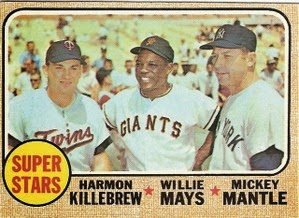
Swinging Sweet


Guess how many home runs ?

A lot. I will divulge later on. Mays was maybe the best fielder of the three. Killebrew maybe the most clutch. Mantle, the best switch hitter and also a damn fine base runner, apologies to Willie.

It doesn't matter how many they  hit, it matters how they hit them.

All these hitters had sweet swings,
and all has Hall of Fame careers.


Killebrew was the pure slugger, Willie Mays the pure hitter, and Mickey Mantle was pure genius.

I don't care how many home runs each of them got, but to be fair, Mays hit 660, Killebrew hit 573, and Mickey Mantle hit 536 long balls.


In 68 , we had quite a year, the Hawk led the AL in Rib Eyes, just a few more than Frank Howard and quite a few more than 3rd place Jim Northrup of the Tigers.

Monday, April 24, 2017

Zach Wheat

Born in Hamilton, Missouri, he was the son of Basil and Julia Wheat. His father was of English descent and his mother was full-blooded Cherokee. Wheat began his professional baseball career in 1906 for Enterprise in the Kansas League, followed by Wichita in 1907, Shreveport Pirates of the Texas League in 1908, and finally, to round out his minor league career, he played for the Mobile Sea Gulls of the Southern Association in 1909. It was during that 1909 season that the Brooklyn Superbas of the National League purchased Wheat for $1200, and he made his Major League debut in September. He batted with a corkscrew type of swing, and held his hands down near the end of the bat, unlike most hitters during his time, a time noted as the "Dead Ball Era". Even with his consistent high levels of hitting, he was also noted for his graceful and stylish defense.


Wheat played his first full season in 1910. He played every game for the Superbas that season as the regular left fielder, leading the league in games played. He batted .284 that season, the second-lowest average of his career, which led the team, and was among the league leaders in hits, doubles, and triples. It was in 1911 that his reputation as a slugger began to take hold. Along with hitting .287, he finished eighth in the league with 13 triples, and slugged five home runs. In an era when players rarely hit double-digit home runs for a season, five was enough for people to take notice
Wheat continued his steady and consistent climb up the batting charts in 1912, hitting .305, and finished the season among the league leaders in home runs and slugging percentage.[1] Over the next four seasons, he continued to be among the leaders of many offensive categories; such as home runs, batting average, slugging, hits, doubles, triples, and RBIs. It was during the 1912 season that Wheat married Daisy Kerr Forsman, and she became his default agent, encouraging him to hold out for a better contract each season. Players in his day signed one-year contracts before every season. Each time he held out, he received more money, the club not wanting to lose one of its best players and the team's most popular player. 
His tactic of threatening to hold out served him well during throughout his career, including during the World War I era, when he raised and sold mules to the United States Army as pack animals. He claimed that he did so well, that he didn't need to play during the summer. The team, fearing that they might lose a great player during the prime of his career, would succumb to his demands every year.

Zack Wheat baseball card, 1911 Gold Borders (T205)
In 1916, he topped off the string of seasons with a finish in the top ten in all the above categories, topping the league in total bases and slugging.] He also had a career-high hitting streak, which reached 29 games The Brooklyn Robins won the National League pennant that season. In the World Series, they faced the Boston Red Sox, which had the formidable pitching rotation of Ernie Shore, Dutch Leonard, Carl Mays, and Babe Ruth. The Red Sox won the series four games to one, holding the Robins to a .200 batting average, and Wheat to a paltry .211.
During the 1917 and 1918 seasons, Wheat hit well, but missed many games due to injuries. He had tiny feet, size 5, and this is believed to be the cause of the many nagging ankle injuries that caused to miss many games in his career. He did, however, lead the league in batting average for the only time in his career with a .335 batting average, his highest average up to that point. Interestingly, for a player known as a slugger, and consistently in the top ten in most offensive categories including home runs, he hit zero that season, and just one the season prior.
Starting in 1919, Wheat returned to the league slugging leaders once again, as the baseball began to become livelier, proved by the offensive output by the likes of Ruth, and Rogers Hornsby. The Robins made their second World Series appearance in 1920, this time facing off against the Cleveland Indians. The Robins lost this series as well, 5 games to 2, although Wheat's hitting greatly improved this time around, batting .333. Wheat's statistics climbed during this new live era of baseball, reaching double-digit home runs for the first time with 14 in 1921, and again three more times in the next four years. Wheat hit .320 or higher every season from 1920 through 1925, topping out with .375 in consecutive seasons. He failed to lead the league in hitting those two seasons, not getting enough at bats in 1923 to qualify, and Hornsby topped the league with .384,] and in 1924, his .375 finished a distant second to Hornsby's .424.

A subtle, but longstanding friction existed between Wheat and his manager, future Hall of Famer Wilbert Robinson. The friction reportedly stemmed from Robinson's belief that Wheat seemed to pursue the manager's job behind his back. When owner Charles Ebbets died in 1925, new team president Ed McKeever reassigned Robinson into the front office and named Wheat as player-manager. Newspapers confirm that he managed the Dodgers for two weeks. McKeever caught pneumonia at Ebbets' funeral, and died soon afterward, and Robinson quickly returned to the managers position. As it turned out, Wheat never again managed in the majors, much to his disappointment. To add insult to injury, Wheat's 1925 managerial stint never made it into the official records. In 1931, Steve McKeever, Ed's brother, hired Wheat as a coach, leading to widespread speculation that Zack was being groomed for the manager's spot, threatening Robinson's job for a second time in seven years, and he treated his former star as coldly as ever.
Wheat was signed by the Philadelphia Athletics after his release from Brooklyn in 1927. After the season, he was released again; this time he signed and played for the minor league Minneapolis Millers of the American Association. He played very little that season due to a heel injury, and retired from playing for good following the season.He still holds the Dodger franchise records for hits, doubles, triples and total bases.

Post-career

After Wheat retired from baseball, he moved back to his 160-acre (0.65 km2) farm in Polo, Missouri, until the Great Depression forced him to sell it in 1932. He moved to Kansas City, Missouri, where he operated a bowling alley with Cotton Tierney.[4][10] He later became a police officer. It was during his duties as an officer in 1936, that he was chasing a fleeing felon in his vehicle, when he crashed and nearly died. Wheat spent five months in hospital after the accident, and after he was discharged, he moved his family to Sunrise Beach, Missouri, a resort town on the Lake of the Ozarks, to recuperate. It was here that he opened a 46-acre (190,000 m2) hunting and fishing resort.
One of the grandest guys ever to wear a baseball uniform, one of the greatest batting teachers I have seen, one of the truest pals a man ever (had) and one of the kindliest men God ever created.
Wheat was first voted into the Baseball Hall of Fame by the Veterans Committee in 1957, but could not be inducted, due to the fact that he had not been officially retired for the required 30 years. In 1959, the committee unanimously elected him. In 1981, Lawrence Ritter and Donald Honig included him in their book The 100 Greatest Baseball Players of All Time. In 2006, the stretch of Route 13 that runs through Caldwell County, Missouri was named the Zach Wheat Memorial Highway. Due to his Cherokee ancestry, Wheat was featured in "Baseball's League of Nations: A Tribute to Native Americans in Baseball", a 2008 exhibit at the Iroquois Indian Museum in Howes Cave, N.Y.

Thursday, August 1, 2013

Wilbur Wood


Wilbur Forrester Wood, the knuckler.

The end of Wilbur Wood's 18-year career came after the 1978 season, just two years after his kneecap was shattered on a line drive by Detroit's Ron LeFlore.
But it wasn't by choice.

"I didn't retire, I never retired," said the 60-year-old Wood, who now lives in Bedford, Mass. "Nobody offered me a uniform."

At the time of the injury Wood was 4-3 with a 2.24 ERA and the most durable pitcher in baseball. He had averaged over 300 innings a season since 1971 and was only 34 at the time of the accident.


"I've never been shot," Wood said. "But I guess it felt like a gunshot wound. I can remember it because LeFlore hit the ball inside out and when anybody hits the ball inside out it's tough to pick up. I wasn't trying to catch it I was trying to get the hell out of the way."

There's little doubt in Wood's mind that the freak occurrence led to a premature end of his career.
"No question about it," Wood said. "I was throwing the ball good at that time, I guess. If it hadn't happened I'm sure I could have had many more years. I can't complain. I had a good career.
Wood began his career with Boston in 1961 and also spent some time with Pittsburgh before the Pirates trade him to the White Sox in 1966.

Over the next 12 seasons Wood had one of the most remarkable and versatile runs of the modern era. During his first four seasons with the Sox Wood was a spot starter and closer, at least as the burgeoning role was defined at that time.


"When we pitched relief it wasn't uncommon to pitch three innings," Wood said. "If you were a closer back then you were expected to go three innings and you were expected to do that day in and day out. It's all changed. Whether it's good, bad or different, I have no idea."
Wood posted a career-high 21 saves in 1970, the same year that Chuck Tanner took over as the White Sox manager in mid-season. When 1971 began Tanner and asked Wood to move into the rotation.

Wood had found a new salvation.

It was a great move for the Sox as Wood won at least 20 games each of the next four seasons but it was hard on Wood, who relished playing nearly every day or at least coming to the park knowing there was a chance to get in.

From 1971 to 1974 Wood threw 85 complete games and threw over 300 innings each season, including a high of 376 2/3 innings in 1972 when he went 24-17.

There were mainly four-man rotations back in the 70's which meant Wood sat three of every four games, which was far too much for him.

"I pitched a lot of innings but the worst thing about being a pitcher, especially a starter, is coming to the ballpark and knowing I'm not going to participate," Wood said. "That was my philosophy. I'd take hundreds of ground balls in the infield, I enjoyed that. Every time you took a ground ball you had to pick that up and throw it back in. So you were getting some throwing in."
Wood began throwing the knuckleball as a kid but never really used it professionally until he came to a sobering realization.

"I couldn't get anybody out with my fastball and curveball for three or four innings," he said.
And thus began Wood's career as a knuckleballer. Even now there are usually no more than a few big leaguers who throw the knuckeball -- Detroit's Steve Sparks and Boston's Tim Wakefield come to mind -- and it wasn't much different in Wood's day.
What he loved so much about that pitch was that it allowed him to be on the field far more often than if he was wearing down his arm throwing curvers and sliders.

Wood might best be remembered for being perhaps the last pitcher to throw both ends of a double-header, a feat he accomplished twice in 1973. The first began with the completion of a suspended game but the second was a true double-header against the New York Yankees in which he started and lost both games.

"We had a suspended game (against Cleveland) and my turn was to pitch the next day," Wood said. "I picked up the suspended game and happened to go five or six innings. Dick Allen hit a two-run homer to win it, then I went out and won the next one."
Wood didn't consider staying in baseball after he finished playing. All those years on the road had taken its toll and returning to a quiet New England life was an inviting proposition.

"I really didn't (want to coach) because of the travel," Wood said. "You had a home six months of the year in one port and six months in another. I had enough of the travel."
Wood opened a fish market near his hometown of Bedford, Mass. and then after about five years he moved in another direction, entering a business -- medical sales -- that enabled him to put his reputation as a baseball player to good use.

"It helped a great deal because I had the New England territory and I was pretty well known out here in New England." Wood said. "You make the initial call and they wanted autographs for theirs sons, grandsons. I said I'd give you a picture and I could show up with it. I didn't have to have an appointment.

"That gets you in the door. I did have a pretty good idea of what I was doing so it was secondary but it helped a great deal."
Wood was a Red Sox fan growing up and still enjoys watching the games on television but doesn't get out to the ballpark very often. He decided not to make the trek to Fenway last week when the White Sox were in town.

"I don't want to go to the ballpark," Wood said. "I enjoy it on TV because if it's a good ballgame I'll watch it. If it's a lousy ballgame I'll flip to something else."

However, he would have liked to have been there to see Derek Lowe and Jon Garland each throw gems for their respective teams, it brought back memories of how pitchers used to throw.

"Watching a game today I see too many pitchers that all they do is nit-pick," Wood said. "They don't challenge hitters, they don't go after hitter. Take the Red Sox right now. (Pedro) Martinez goes after them, Lowe goes after them. But now there are three more starters to go through and all they do is nitpick here, nitpick there. Go after them. They don't go after them like they used to."

Many players remain in the cities were they experienced their greatest success on the field but not Wood, who was attending his wife's retirement party on the night that Garland beat the Red Sox.

"Chicago was great," he said. "I loved everything, no doubt about it but I live in Bedford and when you can jump in your car and drive to the National Seashore or two hours to the White mountains, New England has so much to offer that we just love it out here."


Thursday, July 18, 2013

The Colour of Sucess


Dredging the past and looking through the games origins you are bound to uncover nuggets of history, good and bad.


In terms of the bad, every time I read about the treatment of the players by the owners I cringe, and what was worse was how the game treated black players.

Black players eventually found a few benefactors and built their own league, and some did well enough financially, but many deemed it no better than organised slavery, in uniforms.

The white baseball players tried to form a union, or at least achive a semblance of basic players rights, but were dismissed and some who were identified were treated worse, and driven from the game, if possible.

Some black players tried to portray themselves as Cubans, or Spanish, or even native Indians, but black fans came out in droves to watch these players play, and so the disguised were found out, and were banished.

If you were an owner in the early years, before 1900, you controlled the fate of the peoples lives, it was as Marvin Miller coined , the "plantation" .

In coming days, I will chronicle the heroes of the Negro Leagues, the teams, the stars, and the way they were treated, by the white only major leagues, and the owners, and politicians.

Cool Papa Bell, Jackie Robinson, Roy Campenella, Satchel Paige, Curt Flood, and Ritchie Allen. Bog Gibson, Frank Robinson, Jim Rice, and many others. The separate quarters, the coloured part of town, the couloured hotels for blacks, and dressing rooms. 

Most people have no recollection of the integration process, and the hardships these players endured.  The first black manager, bench coach, stadiums filled with all black spectators , stadiums like Wrigley Field, Yankee Stadium, and Ebbets Field.

Black players in the 1960's were routinely paid 40 % less than their white counterparts, owners thought that with all that money in their hands, God knows what would happen.


Outer Space

Now pitching for the Alaska Goldpanners.  Wil-I -Am Lee, better known as the spaceman.


I short diversion from stars of yester-year , to acknowledge Bill Lee, known around baseball as the funniest or craziest of the ex players.

Dirk Hayhurst is coming on as a next era funnyman, writing about his exploits in the minors, but a backstage approach to riding buses in Texas, California, and Arizona, but make no mistake, his inspiration must have been Lee.

I would argue that irreverent baseball players turned writers goes back to Jimmy Bouton's vaunted "Ball Four" , a taboo piece about the New York Yankees, of Mantle, Berra, Martin and Ford. Trouble was the Yankees are sacrosanct and his stories about drunken parties, players kissing on the bus did not go over well.

By the time Billy started writing, we were into a different era, post Watergate, post Iran Contra, and the gloves were off.  Bill has missed out on Twitter, Facebook and blogging but Hayhurst will be the next generation, with ready quips during games, or pictures posted.

We now live in an instantaneous society whereupon if you think it, you can make it viral. Just push the button, and it is out there.

Bill Lee was a decent self made left hander born in California, to a sports oreinted family and he worked his way to the Boston Red Sox and was a key contributor for several seasons. His time was ended by a trade to the Expos until personal friend Rodney Scott was let go in a cost cutting measure.